
SKIBIDI TOILET WAR Wave Survival Guide: Wave Flow, Boss Timing and Run Pacing
How a standard SKIBIDI TOILET WAR wave-survival run escalates: one arena, 50 advertised waves with a boss every fifth, a power-up card after every wave, and how to pace difficulty, squads and metal across ten boss fights.
A standard SKIBIDI TOILET WAR wave-survival run has one shape: you pick an operator, drop into a single arena, and survive wave after wave of skibidi toilets, with a giant boss crashing in every fifth wave. Per the game's own description as of 2026-09-21, that means 50 waves and 10 boss fights, and after every single wave — boss or not — you pick a power-up card to keep building your fighter. One caveat before you queue up: the advertised run length was raised from 24 to 50 waves during September 2026, so wave counts are update-sensitive, not fixed. What the game's public description does not spell out is an ending sequence for clearing wave 50, so the honest way to plan a run is around its verified checkpoints: ten boss fights and a card decision after every wave.
Setting up before wave 1
Your run is defined in the lobby:
- Pick your operator. You play as the fighter itself, not a commander behind one — operators span Cameramen, Speakermen, TV Men and Titans, and the current description advertises 9 fighters with 14 loadouts, each playing completely differently. Every fighter has 4 ability slots; the description's examples let you hurl an enemy into the crowd, call in an airstrike, or drop a bass wave that splits the horde.
- Pick a difficulty that fits you. The official how-to-play text ranges it "from a quick warm-up to a brutal marathon." If you've seen older lists promising six difficulty tiers or an Endless mode, those appeared in early-September 2026 descriptions; the current 50-wave description no longer mentions either, so don't count on them until you see them in-game.
- Fight solo or squad up. Squads hold up to 8 players, and you can revive friends when they go down — squad runs also climb the trophy leaderboards together.
From there you drop into the arena and wave 1 begins. If you spot Heavy Guns on the mode menu, that's the separate boss-rush mode for veterans — a different structure from the standard wave-survival run described here.
How the waves flow
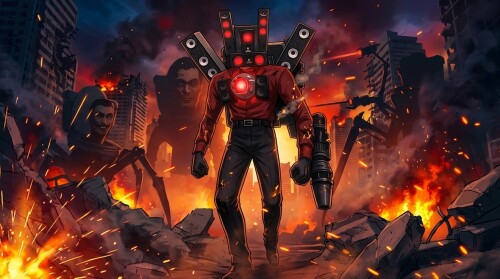
Each wave sends toilets into the arena; clear it, and the game immediately hands you a build decision. The official how-to-play puts it as "choose power-up cards between waves to build your run," and the description sets the cadence plainly: pick a new upgrade after every wave. The card you take then shows at the top of your screen with its effect text — one recorded run, for example, landed Killer Instinct 2.5, damage per combo stack up to 50%. That same recorded player found the pick window short enough that he locked a card in before reading what it did, so skim the effect line fast or you'll take an upgrade blind. Because a fresh card lands after every wave, builds diverge quickly — the description's own promise is that no two runs are ever the same.
Boss timing: every fifth wave
Bosses arrive on a fixed cadence: every fifth wave. Across a 50-wave run that's 10 boss fights — waves 5, 10, 15, 20, 25, 30, 35, 40, 45 and the 50th wave itself, so a full run finishes on a boss. Bosses aren't static damage sponges either: they change tactics as their health drops, and the description notes that G-Man doesn't just hit harder — he opens new ways to hunt you. Expect the same boss to behave differently at low health than it did when it crashed in. The official counterplay guidance is to learn their attacks, dodge the big hits, and take them down.
What escalates as the run goes on
The verified escalation in a standard run is boss pressure: the every-fifth-wave cadence plus the mid-fight tactic shifts as boss health falls. Between those arrivals, your job stays the same — clearing waves of skibidi toilets. The game's public description doesn't break down wave-by-wave enemy pressure into spawn counts, health growth or elite timing, so there are no per-wave numbers to build around; treat the boss cadence as your run's clock instead. The other thing that has escalated is the run itself: 24 waves in the description dated 2026-09-02 became 50 from 2026-09-06 onward, which is exactly why the current figures carry a date and deserve a recheck after mode updates.
Pacing and planning your run
Your difficulty choice sets the tone before wave 1, and it's worth matching to your session — the game advertises everything from a quick warm-up to a brutal marathon. In squads, plan around the revive: downed friends can be brought back, which makes pushing deeper a shared decision rather than a solo gamble. On builds, stay flexible — with a new card after every wave, the fighter you're piloting at wave 40 can look nothing like the one you started with.
The waves also feed your account between runs: metal drops from enemies during runs, and bosses always drop 15 to 25 pieces. Metal is the currency for upgrading operators' gear and is separate from normal gold (Robux can also buy it if you'd rather skip the grind), so the enemies you clear each wave keep paying into your upgrade path even after the run. Working codes hand out free gold and metal as well; the dedicated Codes page keeps the live list.
As for the finish line: the game itself leans on the question "How far can you get?" and trophy leaderboards rather than advertising what clearing wave 50 triggers. Pace your run around what's verified — ten boss fights on a every-fifth-wave clock and a build decision after every wave — and let the leaderboard depth be the goal that scales with it.
Related Guides
Bosses and Adaptive Phases
Each confirmed boss, how adaptive phases change the fight, and the survival habits that beat boss waves.
Power-Up Cards and Effects
What every between-wave power-up card does, which verified picks are strongest, and when to take them.
Difficulty Options Compared
Every difficulty option and the verified differences in rewards and enemy pressure, so you can pick your mode.
Squads and Co-op Rules
How to create or join a squad, the co-op rules, and what changes when you play with friends.