
SKIBIDI TOILET WAR How to Play: The Run Loop and First Decisions
How a SKIBIDI TOILET WAR run works: pick an operator, choose solo or squad, mode and difficulty, survive waves, grab power-up cards between waves, handle bosses, and spend run metal on operator upgrades.
A normal run in SKIBIDI TOILET WAR is one repeating loop: pick an operator, drop into the arena, survive wave after wave of skibidi toilets, choose a power-up card after each wave, and take down the giant bosses that crash in along the way. The official description sums up the game as standing your ground against the toilet invasion — and you do the standing yourself. Recorded first-impression sessions make the point clearly: you don't control a squad of units from above, you become the character and fight in first person on the arena floor.
The whole sequence looks like this:
- Pick your operator — a Cameraman, Speakerman, TV-man, or Titan, equipped from the character menu.
- Set up the run — solo or a lobby squad, a mode, and a difficulty.
- Fight each wave yourself — click to punch, and fire your skills when they count.
- Choose a power-up card the moment the wave ends; this repeats after every single wave.
- Handle the boss when one crashes in — every fifth wave in classic's 50-wave structure as of the late-September 2026 in-game description, or every wave in Heavy Guns.
- Turn run loot into permanent power — metal from enemies and bosses pays for operator upgrades that outlast the run.
The game frames the whole thing as one question: "How far can you get?"
One caveat before the details: this game updates fast. Archived versions of the in-game description within September 2026 counted different wave totals (24 in one, 50 in another), so the numbers below are current for the late-September 2026 description and should be expected to move.
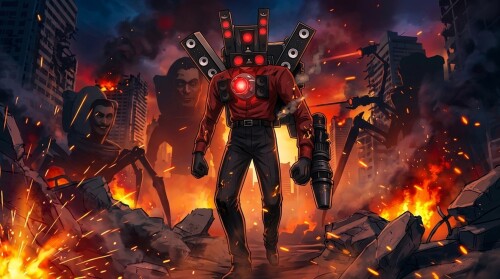
The four choices before wave one
1. Your operator. The roster is built around four families — Cameramen, Speakermen, TV-men and giant Titans — and each has its own weapons, abilities and ultimate, with upgrades unlocking stronger versions. The archived description stresses that every fighter plays completely differently, so your operator is less a skin and more the foundation of your run. The choice also isn't locked for the session: recorded play shows you can change your operator for the next round, which turns later waves into a planning problem — once you know which bosses are coming, you can swap into a better-suited pick.
2. Solo or squad. You can fight solo or team up with friends in a squad. Archived in-game text lists squads of up to 8, formed in the lobby, where you can revive downed friends and climb the trophy leaderboards together. For a very first run, though, solo is where the game itself sends you.
3. Mode. The official HOW TO PLAY list and recorded menu footage show three directions:
- Classic — a wave of enemies and bosses, and you choose how hard.
- Heavy Guns — "a boss rush for veterans": you protect your base, and a boss comes every wave.
- A base-destruction mode — the menu footage also shows an option about destroying the enemy base; its exact rules aren't spelled out in the description, so treat it as something to try rather than a documented formula.
4. Difficulty. The official text keeps this deliberately qualitative — "a difficulty that fits you, from a quick warm-up to a brutal marathon" — and recorded menu footage shows easy, medium and hard options. Older archived text mentioned six tiers and an Endless mode, so the exact count has changed between versions. If you're brand new, start where the tutorial starts: one recorded tutorial run walks the player straight into solo classic on easy.
During a wave: you are the fighter
A recorded tutorial run shows the basic controls as the game teaches them: you click to punch toilets as they pour in, and you have numbered skill slots for bigger hits. The tutorial actively stops the player from mashing those skills — "we can't just use skills randomly" — so treat skills as a paced resource for crowded moments rather than something to spam at the first toilet. Each fighter has 4 ability slots, and the archived description gives a taste of the range: hurl an enemy into the crowd, call in an airstrike, or drop a bass wave that splits the horde.
Between waves: pick your card
The moment a wave ends, the game prompts an upgrade pick before the next wave begins — the tutorial run shows exactly this beat: wave cleared, choose the upgrade, next wave starts. The official rule is "choose power-up cards between waves to build your run," and the archived in-game text adds that you "pick a new upgrade after every wave. No two runs are ever the same." That after-every-wave cadence is the game's core decision loop: each card stacks on top of your operator's own weapons, abilities and ultimate, so the same character plays differently from run to run.
Bosses: the reason to plan ahead
Boss cadence depends on your mode. In classic, the late-September 2026 archived description lays it out plainly: "One arena. 50 waves. A boss every fifth one," counting 10 boss fights in total. In Heavy Guns, the rhythm collapses — a boss comes every wave while you defend your base.
The official instruction for handling any of them: learn their attacks, dodge the big hits and take them down. The archived text adds the detail that matters most — bosses change tactics as their health drops. Its example is G-Man, who "doesn't just hit harder — he opens new ways to hunt you." Expect a boss that fights differently at low health, not just a bigger damage sponge. This is also where the between-round operator swap earns its keep: knowing which bosses are ahead lets you change into an operator whose kit answers them.
After the run: metal, upgrades, and the surrounding systems
Runs feed permanent progression:
- Metal is the upgrade currency. It is separate from normal gold, and the game states the source in plain terms: "Metal drops from enemies in runs. Bosses always drop 15 to 25 pieces of metal."
- Upgrades unlock stronger versions of your operator — and they change the look, not just the stats. On one recorded Titan upgrade track, costs ran 60 → 180 → 600 → 1,600 metal, then a mythic tier and a legendary at 4,800. Those exact figures come from that single track, not a universal price list.
- Robux can shortcut the grind — the upgrade screen offers metal for Robux if you'd rather skip the farming.
- Around the loop sit the meta systems: daily missions, a prize wheel, and codes. Operators get expensive fast, and working codes hand out free gold and metal that make upgrades, missions and the wheel more accessible — the current code list lives on the Codes page.
That's the loop. Pick an operator that looks fun, run solo classic on easy until punching and skill timing feel natural, treat every card pick as a fresh decision, and let the boss waves teach you when to swap. When upgrades start to feel expensive — the description of them getting expensive fast is earned — codes and daily missions are the quickest pressure release.
Related Guides
Power-Up Cards and Effects
What every between-wave power-up card does, which verified picks are strongest, and when to take them.
Wave Survival: Flow and Pacing
How waves progress, when bosses arrive, and the pacing choices that carry a squad into late waves.
Operators: Families and Fighters
Every operator family, their confirmed fighters, and how upgrades shape which picks are worth your Gold.
Bosses and Adaptive Phases
Each confirmed boss, how adaptive phases change the fight, and the survival habits that beat boss waves.