
SKIBIDI TOILET WAR Operators: Families, Confirmed Fighters, and Upgrades
SKIBIDI TOILET WAR's four operator families, the confirmed fighters so far, and how weapons, abilities, ultimates and upgrades fit together.
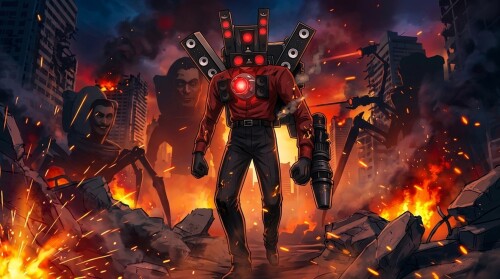
SKIBIDI TOILET WAR operators are the characters you play — not units you command. You pick one, drop into the arena as them, and survive wave after wave of skibidi toilets while giant bosses crash in along the way. The game's official description sorts those characters into four families — Cameramen, Speakermen, TV-men and giant Titans — and gives each family its own weapons, abilities and ultimate.
This page maps the four families, lists every fighter that is confirmed so far, explains how a fighter's kit is put together, and breaks down the version and gear upgrade layers, so you can decide which fighter deserves your gold and metal.
How operators work in a run
Each run starts with one operator choice, and it doesn't lock you in. Once a round ends you can swap to a different fighter before the next one — recorded playthroughs show players doing exactly that, changing operator for the next round once they know how the game plays and which bosses are coming up. Treat the choice as per-run, not permanent.
Two upgrade systems touch a run, and they do different jobs. After every wave you pick a power-up card, a temporary pick that shapes that run only. Operator upgrades — versions and gear, covered below — are permanent and follow the fighter between runs. Don't confuse the card picks you make every wave with the upgrades you buy in the character menu.
The four operator families
The official description names the four families — Cameramen, Speakermen, TV-men and giant Titans — and gives each its own weapons, abilities and ultimate, with upgrades unlocking stronger versions. The description also insists that every fighter plays completely differently, so think of the family as the broad grouping and the individual fighter as where the actual play style lives. Which fighters belong to which family is documented below, with one gap: the recordings never label Plungerman's family.
Fighters confirmed so far
The roster moved fast. The game's own description, as archived through September 2026, counted three fighters on September 2 — Cameraman, Camerawoman and Largecameraman, each with three upgrade tiers — then six on September 6, when Speakerman, Speakerwomen and Largespeakerman joined, and nine by September 16, at which point the description stopped naming the added fighters. A later snapshot kept the nine-fighter count and was then replaced with the placeholder "Update. This area will be updated shortly." The current store page names only the four families. So there is no complete public list of the current nine fighters; what follows is every fighter documented by the game's archived descriptions or visible in recorded gameplay.
| Fighter | Family | What the recordings show |
|---|---|---|
| Cameraman | Cameramen | V2 and V3 purchases shown; his versions displayed "gear coming soon" in the gear-update recording |
| Camera Woman | Cameramen | Menu showed versions two, three and four |
| Largecameraman | Cameramen | Named in the game's six-fighter description; not shown in the recorded menu visits |
| Speakerman | Speakermen | Version two shown |
| Speaker Woman | Speakermen | Present in the menu; no gear track shown in the gear-update recording |
| Large Speakerman | Speakermen | No second version available when recorded |
| Plungerman | Not labeled in the recordings | Version two shown |
| TV Man | TV-men | No other versions shown |
| Dark TV Man | TV-men | Present in the menu |
| Titan TV Man | Titans | Had just been added when one session was recorded |
| Titan Speakerman | Titans | Version two shown, with an "upgrade gear V2" option |
The archived description spells the large and female fighters "Largecameraman", "Camerawomen", "Speakerwomen" and "Largespeakerman", while the menu recordings show "Large Speakerman", "Camera Woman" and "Speaker Woman" — they are the same fighters. And because three roster bumps landed between September 2 and September 16, 2026 alone, check the character menu in game for the live list before planning long-term spending.
Inside a fighter's kit
Open any fighter in the character menu and you get a full stat list plus an abilities panel — the recorded playthroughs linger on exactly that screen. The kit follows one published structure: every fighter has four ability slots, and the description's example abilities give a sense of the range — hurling an enemy into the crowd, calling in an airstrike, or dropping a bass wave that splits the horde. Each family also has an ultimate, but the game's public descriptions never name individual ultimates; the abilities panel in the menu is where a fighter's actual list lives. Leveling a fighter up unlocks more kit on top: jetpacks, laser guns, cutting saws, twin blades and sonic waves.
Upgrades: versions, gear, and currencies
Versions
The character menu sells stronger versions of each fighter. One recorded session bought Cameraman's V2 for 4,000 and then V3 for 9,000, with a Robux shortcut offered alongside the currency price. The same menu showed Camera Woman up to version four, while Large Speakerman and TV Man had no second version at the time — not every fighter's ladder is equally deep, so check the menu entry before saving for a specific version.
Gear
A later update layered per-operator gear on top. The gear screen lists every operator you own down the left side, so you can see at a glance who has the capability without clicking through each one. Availability is still partial: in the gear-update recording, Cameraman's versions and Speaker Woman showed "gear coming soon", while Titan Speakerman's version two already had an "upgrade gear V2" option. Where a gear track exists, tiers must be bought in order — the recorded player confirmed you can't skip ahead — and the recorded costs ran the same sequence, 60, 180, 600 and then 1,650, for every operator and even across versions. Titans get one extra wrinkle: their reactor has upgradeable looks.
Gold and metal
Both layers are fed by two currencies. Gold goes straight into operator upgrades, and metal covers the same kind of upgrade spending when a run asks for metal instead of coins. Codes hand out both, and the current list lives on the game's Codes page.
One caution before you budget: the version prices (4,000 and 9,000) and the gear prices (60 through 1,650) come from two different recorded sessions, and the game patched repeatedly through September 2026. Treat all of those numbers as what the recordings captured, not as a current price list.
How to pick
Because you can swap between rounds, trying is cheap and committing is what costs. A workable loop: open the character menu, read the stat list and abilities panel of two or three fighters, take one into a run, then switch after the round if the next boss punishes your pick. Spend currency only after a fighter has survived that test — versions are bought, gear tiers stack up in a fixed sequence, and every fighter plays differently enough that menu stats alone won't tell you which one clicks.
The short version: the four families tell you which kit group a fighter belongs to, the four ability slots and the ultimate tell you what it does, versions and gear tell you how far it can grow, and the between-round swap lets you change your mind.
Related Guides
Operator Upgrades: Requirements and Costs
What each operator upgrade costs, when it unlocks, and what actually changes in a run after you buy it.
Operator Loadouts: Kit Building
How operator kits are structured and the loadout patterns that cover damage, support, and survivability.
Titans: Lineup, Kits, and Gear
The confirmed Titan lineup with each kit and gear upgrade, so you can pick the right Titan for your squad.
How to Play: The Run Loop
A first-run walkthrough of the wave loop, controls, and the early decisions that decide whether you survive.