
SKIBIDI TOILET WAR Operator Loadouts: How Kits Are Structured and Built
How SKIBIDI TOILET WAR operator loadouts are structured — each fighter's own weapon, four ability slots and an ultimate — plus dated loadout counts, what upgrading unlocks, and the build decisions the equip screen documents.
An operator loadout in SKIBIDI TOILET WAR is not a bag of parts you mix freely. Each operator — the game currently names Cameramen, Speakermen, TV-men and giant Titans — ships with its own weapons, abilities and ultimate, and the game's descriptions through late September 2026 advertised "4 ability slots per fighter". Upgrading an operator unlocks stronger versions of those pieces rather than swapping in someone else's gear. That shape decides how you build a setup: read what your fighter's four slots actually do, buy equip-screen upgrades for it, and change operator between rounds when the run calls for a different kit.
What an operator loadout contains
A loadout belongs to one fighter and has three layers:
- The operator's own weapon — its default attack, not a pick from a shared armory.
- Four ability slots — the September 2026 descriptions gave examples like hurling an enemy into the crowd, calling in an airstrike, or dropping a bass wave that splits the horde.
- An ultimate — each fighter's own finisher on top of the slots.
The game stresses that "every fighter plays completely differently," so two loadouts are not interchangeable. Knowing your fighter's full kit before the first wave is the single highest-value step — one recorded player summed up his run as "I guess I should have probably read my abilities."
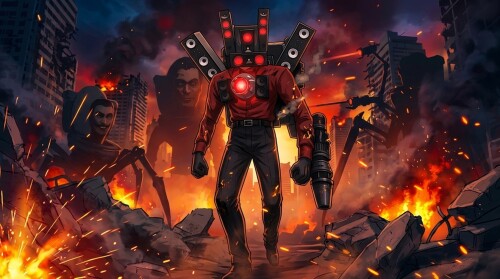
Fighter and loadout counts, dated
The game changed fast through September 2026, and the official description restated its roster and loadout counts several times. If you quote or rely on a count anywhere, anchor it to a date:
| Description version | Loadout line | Fighters named | Gear named |
|---|---|---|---|
| 2026-09-02 | 3 FIGHTERS · 9 LOADOUTS | Cameraman, Camerawoman, Largecameraman | Jetpacks, laser cannons, buzzsaws, heavy shields |
| 2026-09-06 | 6 FIGHTERS · 14 LOADOUTS | Cameraman, Largecameraman, Camerawomen, Speakerman, Speakerwomen, Largespeakerman | Jetpacks, laser guns, cutting saws, twin blades, sonic waves |
| 2026-09-16 | 9 FIGHTERS · 14 LOADOUTS | None named | Not restated |
| 2026-09-21 | Count removed — replaced with "Update. This area will be updated shortly." | None named | None |
| Current page (captured 2026-10-01) | No loadout count shown | Cameramen, Speakermen, TV-men, giant Titans | Not stated |
The counts moved three times in one month, and the "9 FIGHTERS · 14 LOADOUTS" figure is last confirmed in the archived 2026-09-16 and 2026-09-21 descriptions. The current page groups fighters into four families without a count, so treat any loadout total you see elsewhere as a snapshot, not a constant.
What upgrading unlocks
The current official wording is simply: "Upgrade them to unlock stronger versions." Earlier descriptions were more specific — the 2026-09-02 text described three upgrade tiers per fighter granting jetpacks, laser cannons, buzzsaws and heavy shields, while the 2026-09-06 and 09-16 texts listed jetpacks, laser guns, cutting saws, twin blades and sonic waves instead. The gear names changed between versions, so don't treat any one list as the current catalog; the reliable way to see what your fighter's next tier grants is the upgrade flow in-game, where the purchase itself is shown.
Build decisions: the equip screen
A recording dated 2026-10-01 shows what you can actually buy and change. Loadout positions are numbered slots — the creator notes that "in the second position, I've already upgraded it to have a weapon" — and buying an upgrade moved his character to what he calls "version two, which is buying this, but its name is Target Cameraman." During a run he also armed a defensive choice, "Equip the shield slot," which blocks enemies until it triggers (in one laggy wave it briefly failed to activate).
The recording doesn't show prices or the total number of slots clearly enough to copy, so check those in your own equip screen. Timing matters too: the game's update titles show the equip system reworked twice in two days — "[ UPD EQUIP SYSTEM ]" on 2026-09-27 and "[ UPD NEW EQUIP V2 ]" on 2026-09-28 — so treat slot rules as current as of early October 2026 and recheck them after updates.
Using your kit in a run
One recorded session on an upgraded Titan Speakerman (hard "onslaught" difficulty) shows how a kit plays out. His auto attack turned out to be the cannon ("So, what's my auto attack? Ah... it's the cannon"), Shift fired Titan salvo, and the skill on Q he only discovered mid-fight ("Oh wait, what does Q do?"). His chosen perk stayed visible at the top of the screen: "Killer Instinct — 2.5 damage per combo stack, up to 50%." Whether that in-run perk readout is the same thing as the between-wave power-up cards isn't shown in the footage, so treat them as separate systems until you see them linked.
Those bindings come from that one fighter's session. Since the game says every fighter plays completely differently, expect different skills and keys per operator — spend the first wave confirming your own controls rather than assuming this mapping carries over.
Changing operator between rounds
Your first pick is not locked in. The recorded player discovers mid-run: "Oh, I can swap operators. So, I can change," and explains the planning value: "you can change your operator for the next round. So, if you know how the game plays and which bosses are coming up, you can then plan ahead." He makes the swap after an elite jetpack toilet spawns and his current kit is a bad answer to it. Since bosses change tactics as their health drops — the description notes G-Man "opens new ways to hunt you" — treat operator choice as a recurring decision, not a lobby formality.
Matching a setup to the run you want
The documented run formats a setup has to serve are:
- Solo or squad of up to 8, with revives for downed friends and trophy leaderboards to climb.
- Difficulty from "a quick warm-up to a brutal marathon" — a September description also counted six difficulty tiers plus Endless mode.
- Heavy Guns, described as "a boss rush for veterans."
- Power-up cards between waves that "build your run," so no two runs play the same. The September descriptions set the frame at 50 waves with a boss every fifth one.
None of the game's own text prescribes a particular fighter for a particular mode, so the choice stays yours. The routine the evidence supports is: pick the fighter whose four slots match how you like to play, read the whole kit before wave one, buy its equip-screen upgrades, confirm your controls early, and swap operators between rounds when the bosses ahead demand a different answer. For the individual weapons, abilities and ultimates themselves, use the dedicated operator weapons and abilities reference pages.
Related Guides
Operator Abilities and Usage
What each operator ability does, its verified effects, and the usage rules that avoid wasted cooldowns.
Operator Weapons and Pairings
The verified weapon set for each operator and the pairings that perform best against late waves.
Power-Up Cards and Effects
What every between-wave power-up card does, which verified picks are strongest, and when to take them.
Wave Survival: Flow and Pacing
How waves progress, when bosses arrive, and the pacing choices that carry a squad into late waves.